

1962: Enough energy (Humble Oil)
Each day Humble supplies enough energy to melt 7 million tons of glacier!
This giant glacier has remained unmelted for centuries. Yet, the petroleum energy Humble supplies — if converted into heat — could melt it at the rate of 80 tons each second! To meet the nation's growing needs for energy, Humble has supplied science to nature's resources to become America's Leading Energy Company. Working wonders with oil through research, Humble provides energy in many forms — to help heat our homes, power our transportation, and to furnish industry with a great variety of versatile chemicals. Stop at a Humble station for new Enco Extra gasoline, and see why the "Happy Motoring" Sign is the World's First Choice!
Who: Humble Oil (Exxon Company)
Advert: Life Magazine, 1962
Methane: 1238.50 ppb
Source: Life Magazine/Google Books

1970: Progress or the environment? (Marathon Oil)
We'd like them to eat their cake and have it too
Does it have to be progress or environment? We think they go hand in hand. Here's one example. Demand for gasoline in the Midwest is growing, and Marathon sales are growing faster than demand. We're virtually rebuilding our Robinson, Illinois, refinery so 75% of its output can be gasoline. At the same time, we've spent millions on environment controls to make sure cleanliness matches growth. We're giving the same careful attention to clean air and water at our other refineries, too. And we've joined with 10 other companies in a research program to reduce contaminating emissions from auto engines.
For more about what an all-round, hard-working oil company can accomplish, write (Dept. E) for a copy of our annual report.
Who: Marathon Oil
Advert: Newsweek, 1970
Methane: 1351.70 ppb
Source: Newsweek/Pinterest
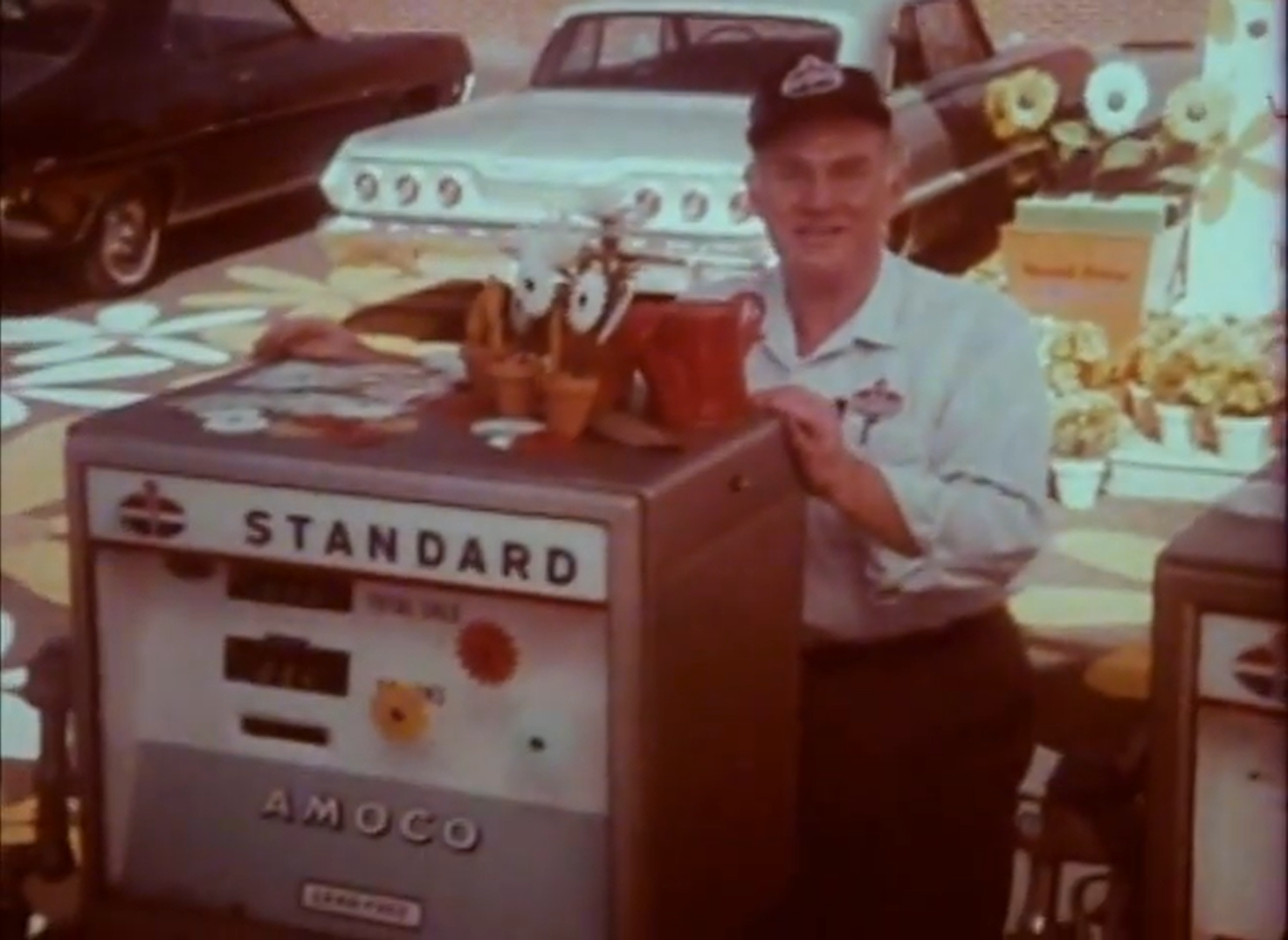
1970: Out to clean the air (Amoco)
We're out to start cleaning the air. And we hope you'll join in by putting this daisy on your car and lead-free amaco, anti-pollution, gasoline in your tank.
I want to give you a daisy and some daisy seeds. Daisies are a symbol of clean air. That we're out to start clearing the air. And we hope you'll join in by putting this daisy on your car... and lead-free amaco, anti-pollution, gasoline in your tank. Come see us at participating standard oil dealers. We're the guys with the daisy. You expect more from standard and you get it.
Who: Amoco/Standard Oil
Advert: National and Regional TV Networks, 1970
Methane: 1351.7 ppb
Source: YouTube

1970: Nice place to live (Shell)
What have you done to your country lately?
Cigarette butts. Gum wrappers. Candy paper. Don't drop them in all the wrong places. Like a sidewalk. Or the highway. Or on somebody's lawn. Or in the gutter. Every once in a while, make a deposit in a waste can at your Shell station. It's a great way to save. The landscape. Now you can visit your Shell dealer when your tank is empty, or when your ash tray is full. That way, you not only keep a tidy car. You get a tidy country to drive it in. Please keep this in mind: if we keep throwing trash away on the streets and highways, we're throwing something else away.
A nice place to live.
Who: Shell
Advert: Look Magazine, 1970
Methane: 1351.70 ppb
Source: Vintage Paper Ads

1984: Lies they tell our children (Mobil)
Why Are They Lying to Our Children?
"I don't have a future." With tears streaming down her face, a 13-year-old girl made this bleak assessment to her father. To back up her pessimism, she had brought home from school a mimeographed sheet listing the horrors that awaited her generation in the next 25 years: Worldwide famine, overpopulation, air pollution so bad that everyone would wear a gas mask, befouled rivers and streams that would mandate cleansing tablets in drinking water... a greenhouse effect that would melt the polar ice caps and devastate U.S. coastal cities... a cancer epidemic brought on by damage to the ozone layer. Moved by the girl's misery, her father, Herbert I. London of the Hudson Institute and New York University, wrote a book, Why Are They Lying to Our Children? The book documents how some of the myths of the 1960s and 1970s…
Who: Mobil
Advert: New York Times, 1984
Methane: 1644.85 ppb
Source: The New York Times

1985: Land will be replanted (Chevron)
The explored land will be replanted so it will soon look as if no one had ever been there.
In a den high in Montana's black feet country a Grizzly settles for a long winter's nap unaware that down below people with motors and machinery will explore for oil through deep winter but before she wakes the people will be gone. The explored land will be replanted so it will soon look as if no one had ever been there. Do people sometimes work through the winter so nature can have spring all to herself... people do.
Who: Chevron
Advert: National and Regional TV networks, 1980’s
Methane: 1657.29 ppb
Source: YouTube

1997: Science what we don't know (Mobil)
Adopting quick-fix measures at this point could pose grave economic risks for the world.
As the debate over climate change heats up, science is being up-staged by the call for solutions. At stake is a complex issue with many questions. Some things we know for certain. Others are far from certain.
First, we know greenhouse gases account for less than one percent of Earth's atmosphere. The ability of these gases to trap heat and warm Earth is an important part of the climate system because it makes our planet habitable. Greenhouse gases consist largely of water vapor, with smaller amounts of carbon dioxide (CO₂), methane and nitrous oxide and traces of chlorofluorocarbons (CFCs).
The focus of concern is CO₂. While most of the CO, emitted by far is the result of natural phenomena namely respiration and decomposition, most attention has centered on the three to four percent related to human activities-burning of fossil fuels, deforestation. The amount of carbon dioxide in the atmosphere has risen in the last 100 years, leading scientists to conclude that the increase is a result of man-made activities.
Although the linkage between the greenhouse gases and global warming is one factor, other variables could be much more important in the climate system than emissions produced by man.
The UN sponsored Intergovernmental Panel on Climate Change (IPCC) thought it had found the magic bullet when it concluded that the one-degree Fahrenheit rise in global temperatures over the past century may bear a "fingerprint" of human activity. The fingerprint soon blurred when an IPCC lead author conceded to the "uncertainty inherent in computer climate modeling."
Nonetheless, nations at Kyoto are being asked to embrace proposals that could have potentially huge impacts on economies and lifestyles. Nations are being urged to cut emissions without knowing either the severity of the problem - that is, will Earth's temperature increase over the next 50-100 years? - or the efficacy of the solution - will cutting CO₂ emissions reduce the problem?
Within a decade. science is likely to provide more answers on what factors affect global warming, there - by improving our decision-making. We just don't have this information today.
Answers to questions on climate change will require more reliable. measurements of temperature at many places on Earth, better understanding of clouds and ocean currents along with greater computer power.
This process shouldn't be short-circuited to satisfy an artificial deadline, like the conference in Kyoto. Whatever effect increased concentrations of man-made gases may have, it will develop slowly over decades. Thus, there is time for scientists to refine their understanding of the climate system, while governments, industry and the public work to find practical means to control greenhouse gases, if such measures are called for.
Adopting quick-fix measures at this point could pose grave economic risks for the world.
Who: Mobil
Advert: New York Times, 1997
Methane: 1754.48 ppb
Source: Geoffrey Supran & Naomi Oreskes

1991: Who told you the earth was warming? (ICE)
Chicken Little's hysteria about the sky falling was based on a fact thar got blown out of proportion. It's the same with global warming. There's no hard evidence it is occurring.
Chicken Little's hysteria about the sky falling was based on a fact thar got blown out of proportion. It's the same with global warming. There's no hard evidence it is occurring. In fact, evidence the Earth is warming is weak. Proof that carbon dioxide has been the primary cause is non-existent. Climate models cannot accurately predict far-future global change. And the underlying physics of climatic change are still wide open to debate. If you care about the earth, but don't want your imagination to run away with you, make sure you get the facts.
Write Informed Citizens for the Environment, P.O. Box 1513, Grand Forks, North Dakota 58206, or call toll-free 1-701-746-4573.
Who: Informed Citizens for the Environment
Advert: Various outlets in ND, AZ, KY, 1991
Methane: 1724.78 ppb
Source: Climate Files

1991: Doomsday is cancelled (ICE)
Doomsday is cancelled. Again. In fact, evidence the Earth is warming is weak.
The twentieth century has seen many predictions of global destruction. In the 1930's, some scientists claimed we were in the middle of a disastrous warming trend. In the mid 1970's, others were sure we were entering a new Ice Age. And so on. It's the same with global warming. There's no hard evidence it is occurring. In fact, evidence the Earth is warming is weak. Proof that carbon dioxide has been the primary cause is non-existent. Climate models cannot accurately predict far-future global change. And the underlying physics of the climatic change are still wide open to debate. If you care about the environment, but don't care to be pressured into spending money on problems that don't exist, make sure you get the facts.
Write: Informed Citizens for the Environment, P.O. Box 1513, Grand Forks, North Dakota 58206 or call (701) 746-4573. We'll send you the facts about global warming.
Who: Informed Citizens for the Environment (Oil Lobby)
Advert: Various outlets in ND, AZ, KY, 1991
Methane: 1724.78 ppb
Source: Desmog

1993: Apocalypse no (Mobil)
Cooling the warming hysteria... Media hype proclaiming that the sky was falling did not properly portray the consensus of the scientific community.
For the first half of 1992, America was inundated by the media with dire predictions of global warming catastrophes, all of which seemed to be aimed at heating up the rhetoric from the Earth Summit in Rio de Janeiro last June.
Unfortunately, the media hype proclaiming that the sky was falling did not properly portray the consensus of the scientific community. After the Earth Summit, there was a noticeable lack of evidence….
Who: Mobil
Advert: New York Times, 1993
Methane: 1736.53 ppb
Source: Geoffrey Supran & Naomi Oreskes

1997: Don't risk our future (Global Climate Coalition)
Americans work hard for what we have Mr President. Don't risk our economic future.
Generations of American families have worked hard to make America's economy the strongest in the world. But that success and the economic security of our future generations is suddenly at great risk. Because right now, our world competitors countries like China, India, Mexico, and Brazil are pressuring the United States to support a U.N. global climate agreement that would force American families to restrict our use of the oil, gasoline, and electricity that heats and cools our homes and schools, gets us to our jobs, and runs our factories and businesses. We'd have to pay more for energy, and, in turn, prices for goods and services would rise. The big countries that compete with America for jobs, trade, and economic security have everything to gain and nothing to lose. Because according to a prior agreement, they won't have to make the sacrifices Americans are expected to make. This also means America's sacrifices will not produce environmental gains. That simply isn't fair, or effective. The climate agreement that President Clinton is under pressure to sign has a big price tag mostly for American. families. It's a bad deal for America. Today. And tomorrow.
Who: Global Climate Coalition
Advert: New York Times, 1997
Methane: 1754.48 ppd
Source: Greenpeace

1991: Global warming may not be true (ICE)
The most serious problem with catastrophic global warming is – it may not be true.
Some forecasters say the Earth's temperature is rising They say that catastrophic global warming will take place in the years ahead. But the US Department of Agriculture-in the first update in 25 years of its "Plant Hardiness Report" -determined that on both coasts of this country, winter temperatures are 5 to 10 degrees cooler than previously reported. The evidence can be seen in the increase in cold damage to Florida orange groves and California eucaliptus. And a moving frost line has led to a shorter growing season in some parts of the South. Now, most of us aren't climatologists. But facts like these simply don't be with the theory that caus trophic global warming is taking place. Which seems to say we need more research. And more evidence. If you care about the Earth - but want to keep a cool head about it - now is your chance to get more facts. Call the Information Council for the Environment, 1-800-346-6269 extension 522. We'll send you a free packet of Information on global climate change. Or just mall us the coupon below.
Because the best environmental policy is a policy based on fact.
Who: Informed Citizens for the Environment
Advert: Various outlets in ND, AZ, KY, 1991
Methane: 1724.78 ppb
Source: Desmog

2008: all of the above (BP)
a) oil,
b) natural gas,
c) wind,
d) solar,
e) biofuels
or .... ✓ f) all of the above
Who: BP
Advert: Various publications, 2008
Methane: 1787.01 ppb
Source: The Guardian
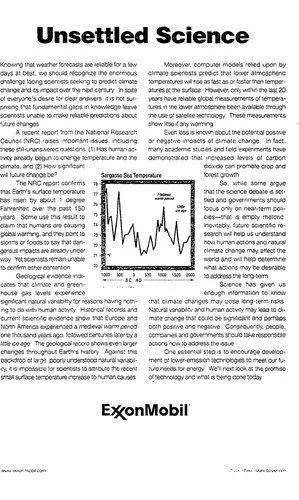
2000: Unsettled Science (ExxonMobil)
Scientists are unable to make reliable predictions about future changes.
Knowing that weather forecasts are reliable for a few days at best, we should recognize the enormous challenge facing scientists seeking to predict climate change and its impact over the next century. In spite of everyone's desire for clear answers, it is not surprising that fundamental gaps in knowledge leave scientists unable to make reliable predictions about future changes. A recent report from the National Research Council (NRC) raises important issues, including these still-unanswered questions: (1) Has human activity already begun to change temperature and the climate, and (2) How significant will future change be? The NRC report confirms that Earth's surface temperature has risen by about 1 degree Fahrenheit over……
Who: ExxonMobil
Advert: New York Times, Wall Street Journal and other publications, 2000
Methane: 1773.22
Source: New York Times
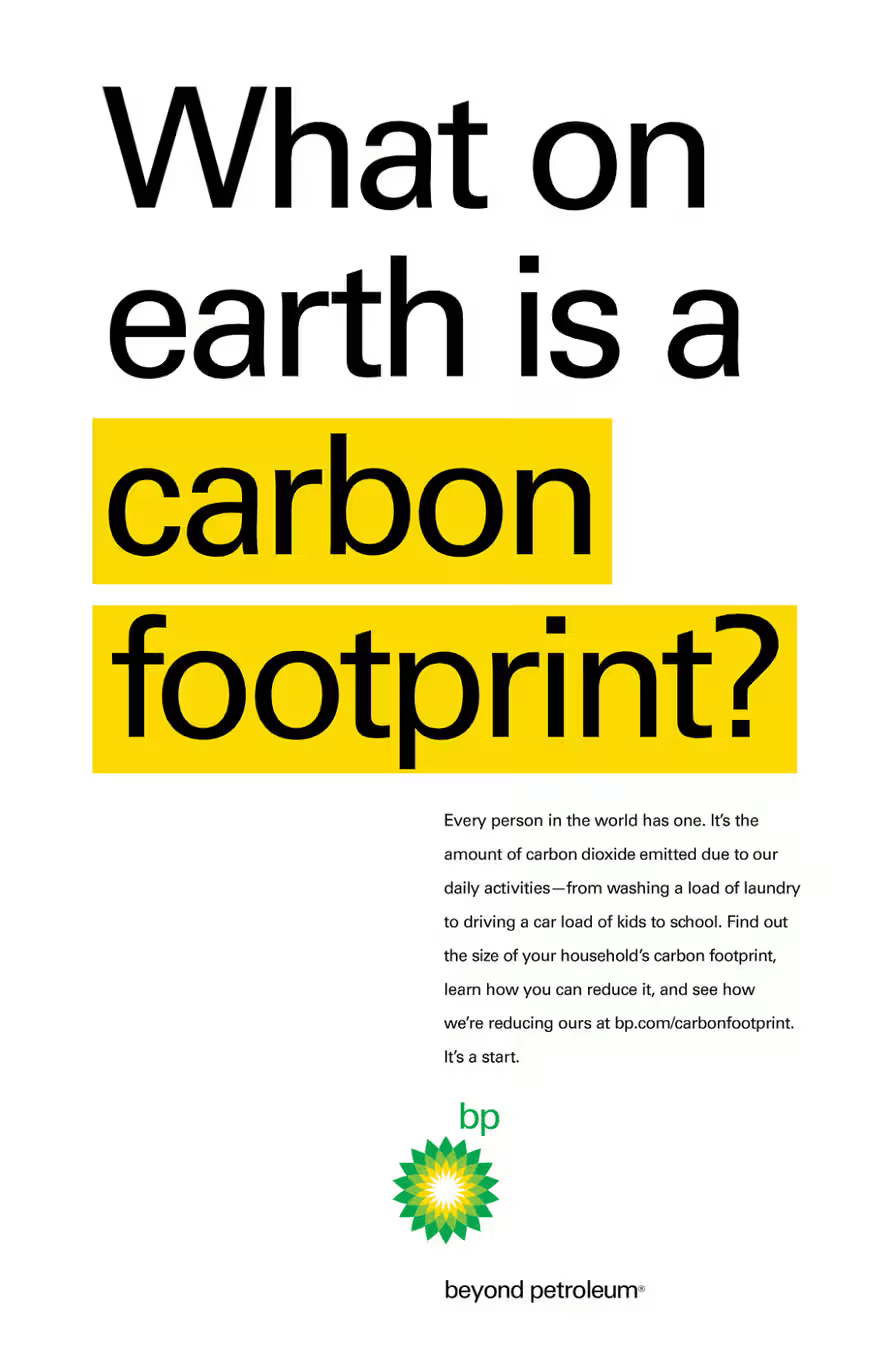
2004: What on earth is a carbon footprint? (BP)
Reduce your carbon footprint. But first, find out what it is
Every person in the world has one. It's the amount of carbon dioxide emitted due to our daily activities-from washing a load of laundry to driving a car load of kids to school.
Find out the size of your household's carbon footprint, learn how you can reduce it, and see how we're reducing ours at bp.com/carbonfootprint. It's a start.
beyond petroleum
Who: BP
Advert: Various publications, 2004
Methane: 1,777.05 ppb
Source: the Guardian

2006: Your carbon footprint (BP)
Reduce your carbon footprint. But first, find out what it is.
Call it your mark on the world. It's the amount of carbon dioxide emitted due to your daily activities - from mowing your lawn to vacuuming your home. Find out the size of your household's carbon footprint, learn how you can reduce it, and see how we're reducing ours at bp.com/carbonfootprint. It's a start. beyond petroleum.
Who: BP
Advert: Various publications, 2006
Methane: 1774.94
Source: Geoffrey Supran & Naomi Oreskes

2017: Oil pumps life (American Petroleum Institute)
This is not your daddy's oil. Oil gushes art. Oil strikes a pose. Oil taps potential. Oil pumps life. Oil runs cleaner. Oil explores space. Together we can power past impossible.org.
Who: American Petroleum Institute
Advert: Super Bowl, 2017
Methane: 1849.58 ppb
Source: YouTube

2019: The future of fuel? (ExxonMobil)
Could a single-celled organism be the future of fuel?
Algae biofuels could one day power planes, trucks and ships - and cut their greenhouse gas emissions in half That's why ExxonMobil and Synthetic Genomics are expanding their research to an algae farm - all part of their plan to have the technical capability to produce 10,000 barrels of biofuel a day by 2025. Read more at EnergyFactor.com
Who: ExxonMobil
Advert: BusinessWeek, 2019
Methane: 1866.58 ppb
Source: Yale

2023: We're part of the solution! (BP)
We have to show people that we're part of the solution!
BP CEO Bernard is interviewed by David Rubenstein, co-founder of private investment firm The Carlyle Group. They discussed how to tackle the energy trilemma – the challenge to provide the world with energy that's more secure, more affordable and lower carbon. “We do that by doing two things. First investing in today’s energy system, which is predominantly oil and gas. And, not or, investing in accelerating the energy transition.”
Who: BP
Talk: Economic Club of Washington, 2023
Methane: 1927.35 ppb
Source: BP

2023: Net-Zero (Shell)
Our climate target
Achieving net-zero emissions is part of our Powering Progress strategy. Our target is to become a net-zero emissions energy business by 2050. Find out more about how we are working to achieve this target and our progress so far. Tackling climate change is an urgent challenge. We want to contribute to a net-zero world where any greenhouse gas emissions entering the atmosphere are balanced by removal out of the atmosphere.
Who: Shell
Advert: shell.com, 2023
Methane: 1927.35 ppb
Source: Shell