Power of Music, 0. Press, 1. Innovation, 2. Exhibition, 3. Music Nick Butterworth Power of Music, 0. Press, 1. Innovation, 2. Exhibition, 3. Music Nick Butterworth

Guitar Magazine feature Beatie Wolfe's work (& guitars)

A lovely interview with Guitar.com's Sean McGeady about ceremony, storytelling, the environment, and of course some guitars... with a highlight on Taylor Guitars reclaimed Urban Ash

BEATIE WOLFE: “WE’RE SO PRIVILEGED IN THE WAY WE CAN HAVE ANYTHING. THAT NEEDS TO BE CHALLENGED. GUITAR COMPANIES SHOULD LEAD THE WAY”

Activist, art maven and maverick musician Beatie Wolfe opens up about her commitment to ceremony, her allegiance to Taylor, and her latest environmental protest piece, From Green To Red.

By Sean McGeady

Many musicians brand themselves as storytellers. But pare back the bluster and their ‘stories’ often amount to little more than music and lyrics. Beatie Wolfe’s work suggests there’s more to it than that. Her stories really do have roots.

Born in London and based in Los Angeles, Wolfe is an old soul for whom music and ceremony are inextricably linked. Her chamber pop protest songs are propped up by fulsome fingerpicking and smokey vocals, and often backed by lush strings or bolstered by rollicking electric licks. But it’s her curatorial approach to packaging and presentation that makes her records remarkable. Wolfe’s stories begin in the earth and, in some cases, literally reach the stars.

Telling stories

“Music and storytelling go hand in hand,” says the artist and activist from her home and studio in LA. “Discovering my parents’ record collection, I saw them as musical books, portals to other worlds. There was the visual aspect, the experiential aspect, the audio aspect – it was a multisensory experience. When we moved from physical to digital, we lost so much. We lost the ceremony. We lost the tangible component. We lost the story.”

Wolfe’s wistful efforts to claim them back, which typically involve weaving old-fashioned notions with newfangled technologies, have seen her work exhibited at the V&A and SXSW, and featured in the likes of Forbes, New Scientist and Wired. But for the 30-something, these aren’t stunts in service of album sales and press attention. Wolfe’s aim is to reintroduce some much-needed pomp and ceremony back into the act of music appreciation – and, paradoxically, it’s the same tech that gave rise to the modern world’s digital distractions that facilitate her attempts to resist them.

Released as an interactive app that allowed users to simulate the traditional gatefold vinyl experience on their smartphones, Wolfe’s 2013 debut Eight set a precedent. For her follow-up, 2015’s Montagu Square, she paid homage to the storied address at which Paul McCartney wrote Eleanor Rigby, her live recording from the venue translated into a geometric pattern and woven into a smart garment in a canny twist on the idea of the record jacket. For her third album, 2017’s Raw Space, Wolfe led an augmented-reality livestream from one of the quietest rooms on the planet, Bell Labs’ anechoic chamber. Not long later, the album would leave the planet entirely, as it was beamed into space using the Labs’ historic horn antenna.

Beatie Wolfe - Raw Space at Holmdel Horn - by Theo Watson.JPG

Wolfe with the historic Holmdel Horn Antenna, New Jersey, from which her album ‘Raw Space’ was beamed

Every act, every album, has its ceremony. But there is narrative not just in Wolfe’s music and its presentation but also in the tools with which she creates it. One of the stories closest to Wolfe’s heart is that of her Taylor 110e.

By the age of 18, Wolfe had already been writing music for 10 years. But she’d yet to buy her first steel-string, having learnt to play on a battered Spanish-style guitar that once belonged to her grandmother. Having saved up, the self-taught player found herself on Denmark Street in search of an upgrade.

“I went into Rose Morris and there was a 110e that had a superficial discolouration on the neck,” she says. “It wasn’t a perfect bit of wood. It was imperfect. The guy that owned the store just said, ‘Look, this should be double the price but we have to sell it half-price because of the discolouration’, which I liked anyway. I thought it was far more beautiful and interesting. That was the first guitar I bought myself.”

The Taylor would serve Wolfe well. In fact, it was her exclusive squeeze for about 15 years. “That was my guitar,” she says. “I was set on only ever playing with that. It has a lot of blood on the inside from when I was doing my bad accenting-the-upstroke strumming and my fingers would be bleeding. That’s not particularly rock ’n’ roll or anything but the fact that it has blood and these dents, and the places I’ve played with it, it really felt part of me.”

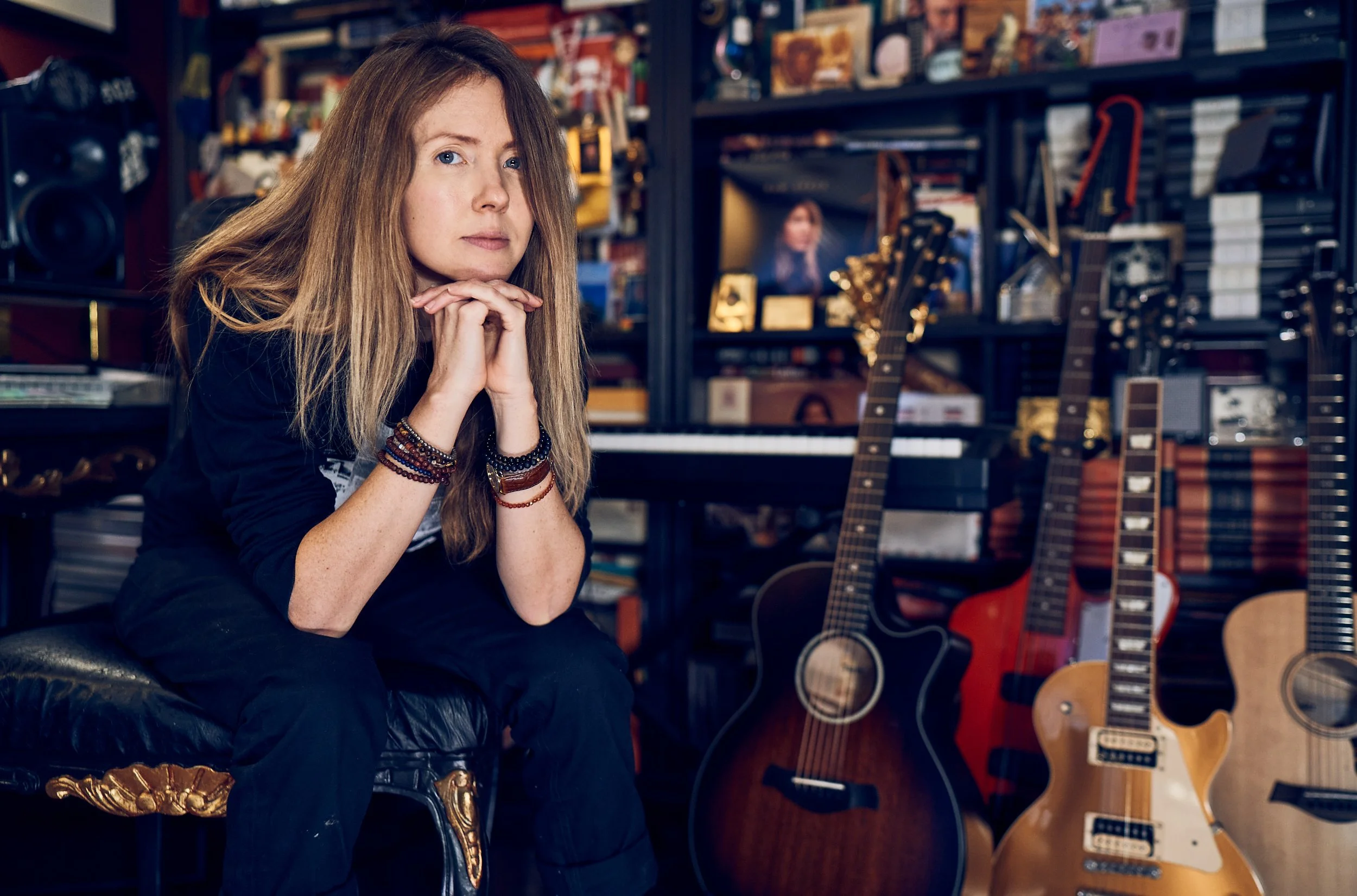
Wolfe’s collection remains relatively small even today. There’s her first electric, a Fiesta Red Fender Stratocaster picked up at London’s New Kings Road Vintage Guitar Emporium, as well a 2017 Gibson Les Paul Classic T Goldtop, with which she summoned the righteous tone on Raw Space cut Pure Being. Then, alongside her Taylor 110e, there’s a Builder’s Edition 324ce and a GT Urban Ash, which lead us to our next story: Taylor’s urban wood initiative.

Beatie Wolfe - Urban Wood - by Ross Harris (1).jpg

Wolfe with her Taylor Builder’s Edition 324ce at West Coast Arborists’ shamel ash inventory in Anaheim. Image: Ross Harris

Dead wood

In an effort to combat the ever-deepening tonewood crisis, Taylor hooked up with Anaheim outfit West Coast Arborists in 2017, with an eye towards giving the arborists’ inventory a more musical future. WCA is tasked with maintaining many of California’s urban trees. Those planted in the mid-1900s and now nearing the end of their life cycles would ordinarily be turned into mulch or burned. Instead, the collaboration sees Taylor using WCA’s stocks of shamel ash to produce musical instruments. In 2020, the first fruits of this partnership were unveiled: the Builder’s Edition 324ce. Given Wolfe’s affinity for Taylor, she quickly became an ambassador for the maker’s efforts.

“It happened in a very natural way,” says Wolfe. “The first guitar I bought was a Taylor. That was the guitar I really connected with. Bob Taylor and I connected fairly recently and got to chat. Sometimes you have an affinity for something and you don’t necessarily know why. Then, after you have a conversation with that person or learn more about that company or initiative, you’re like, ‘Oh, that’s why it always felt good to me’. Bob has always been leading the way with reforestation and being conscious about guitars not having an impact environmentally, and being able to reset or address that. As a wider team, they started learning more about my work. It was more about the stories and the projects than me as ‘a Taylor player’.”

Sometimes hundreds of years long, these stories differ from tree to tree. When a tree’s timber is used in the construction of a guitar, its story is extended. When a guitar is sold on or passed between family members, that story is enriched. Through its urban wood initiative, Taylor is giving California’s city trees an unexpected coda. During her visit to the company’s El Cajon factory in 2019, Wolfe’s 110e was given a coda too.

“The 110e that I’d played for 15 years hadn’t necessarily had a lot of love,” she says. “When I went down to the factory in El Cajon, they actually did a full reconstruction on the guitar, and it ended up being done in the same room that it was built. It wasn’t planned. They just traced what part of the factory that model would’ve been made. There was something really lovely about it getting rebuilt in the place it was built to begin with.”

Taylor working on Wolfe’s 110e in the same room it was originally built. Image: Taylor Guitars

As for what Wolfe reckons to Taylor’s Urban Ash guitars, she doesn’t hear much between them and the company’s mahogany instruments – but that’s kind of the point.

“Honestly, I don’t really analyse. But I was surprised at the tone. It does sound very similar to mahogany. It’s almost like you can’t tell the difference. It was more about the story, the reason you would have a guitar like that to begin with. To have something that’s been sourced from city trees, that’s why I got excited about it. The Taylor ethos has been something I connect with. It’s like, lead with the story and the why, and then if it isn’t doing anything dramatically different either way, then why not?”

Inconvenient truths

For Wolfe, the why can be traced back to a single moment: when she saw Al Gore’s 2006 climate-crisis documentary An Inconvenient Truth, which inspired her not only to write new music but to take up environmental activism and make significant changes to the way she lived.

“It really shook me. It was one of those moments in my life where I was like, ‘What the fuck?!’,” she says. “After that, everything changed.” Wolfe made efforts to limit her environmental impact – a large part of the reason that she stuck with only her 110e for so many years.

“By chatting with Bob a couple of years ago, I became much more conscious of the devastation [in the guitar industry],” she says. “Even thinking about the neck of the 110e and how that meant that the guitar was half-price – it was lucky it was even half-price because a lot of the time, if you don’t get this perfectly uniform, monochrome piece of wood, it would just be disposed of. That idea of the aesthetic aspects of a guitar being so environmentally impactful was a big reason I got involved with the Urban Ash. I was amazed we hadn’t been thinking about that for longer.”

Myth and marketing present a massive hurdle for eco-minded guitar makers, with companies such as Taylor continually combating the notion that the perfect tone is only available through old-growth Brazilian rosewood or Honduran mahogany. But dwindling supplies of tonewoods aren’t the only environmental issues facing the industry today. Animal glues, abalone, gut strings, they all have an impact. Does Wolfe think it’s possible to create an entirely sustainable mass-produced guitar?

“Absolutely,” she says. “The Urban Ash is already a good portion of the way there. When you become aware of something, it’s hard to become unaware of it. But it takes so much to provoke or activate that. So much of it is marketing. But ultimately it’s got to come down to the bigger-picture stuff. We have to realise that we can’t continue to live in the way we’ve been living, and that limitations are wonderful.

“We’re so privileged in the way we can have anything at any point. That needs to be challenged. I think guitar companies should be leading the way. Rather than giving people what they want, it should be like, ‘No, we’re going to give you this, because you don’t know what you’re asking for and you probably wouldn’t be able to tell the difference if we didn’t tell you’.”

From Green to Red

On show at this year’s London Design Biennale, Wolfe’s latest project makes clear another inconvenient truth in the story of Earth. An interactive large-scale projection that uses NASA data to chart the human impact on the planet via the escalating CO2 levels in its atmosphere, From Green To Red is set to a track of the same name first featured on Wolfe’s second album.

She wrote the song in 2006, the same night she saw Al Gore’s documentary. But it would be years before she recorded it. “I thought it would be an irrelevant topic,” she says. “I thought, ‘Well, everyone’s going to see this documentary and we’re going to be on a totally different path. Obviously that didn’t happen.”

The seeds of this environmental protest piece were sown two years ago. Introduced by a NASA engineer to the agency’s atmospheric CO2 graphs, which date back 800,000 years, Wolfe felt another shock to her system. “It was the same moment of like, ‘What the fuck?!’ as seeing An Inconvenient Truth,” she says, still bewildered. “How have we got to this point?”

Wolfe’s intention is to take NASA’s cold, hard data and, by setting it to music and making it interactive, ensure that it is tangible, relatable and, yes, ceremonial. If From Green To Red seems to lack the levity of Wolfe’s past projects, that’s by design.

“With the other album experiences, it was much more playful,” she says. “There was more of a conversation to have about some of those installations. But I hope this just provokes awareness.” Wolfe isn’t playing around anymore. From Green To Red is a wake-up call: if we’re going to extend the story of our planet, we have work to do.

See From Green to Red at the London Design Biennale until June 27 here.

Read More
0. Press, 1. Innovation, 3. Music Nick Butterworth 0. Press, 1. Innovation, 3. Music Nick Butterworth

Phoenix feat. Wolfe in their biannual print magazine

Phoenix Magazine highlight Wolfe's Raw Space Big Bang broadcast in their Space Issue

Beatie Wolfe featured in Phoenix Magazine's Space Issue

Order your copy via... LINK or reTweet

Read More
0. Press, 1. Innovation Beatie Wolfe 0. Press, 1. Innovation Beatie Wolfe

Communication Arts feat. Beatie Wolfe's Raw Space

Excerpt from article posted November 2017 profiling Design I/O

Beatie Wolfe Raw Space
Creativity knows no bounds, not even technological ones, at Design I/O
— Communication Arts, Nov '17

Excerpt from article posted November 2017 profiling Design I/O

...Raw Space, which was the world’s first live, 360-degree, augmented-reality stream.

Created for singer/songwriter Beatie Wolfe, it took place on May 5, 2017, at Bell Labs’ anechoic chamber, once the world’s quietest room. To help them out, the team brought in illustrators Josh Goodrich and James Paterson. Working in 3-D illustration program Quill, they created 40 minutes of generative moths and other dynamic elements that floated around Wolfe as she strummed a guitar in the huge and strange space. Over the next week, they also streamed the songs from a record player in the chamber with live visuals.

We’ve only really scratched the surface of merging design and technology.” —Theo Watson. If you’re looking for a major challenge, streaming 4K, 360-degree video while you’re creating generative illustrations in real time fits the bill. “All the tech was on the edge of not being possible,” says Watson. “We were generating stereoscopic 3-D video that’s predistorted. Our software had to create these distortions to perfectly match those of the stereoscopic camera feed so that the generated visuals looked correct when they moved around Beatie.”

To show how tricky and even dangerous this is, at one point, they made the simple mistake of sending the video streams to the wrong eyes. This promptly caused Hardeman, who had volunteered to be a test subject, to become nauseous and rip off the 3-D goggles. But the project came together as one of the most ambitious uses of virtual reality so far....

Read the full article HERE

Page 1

Page 1

Page 2

Page 2

Read More
1. Innovation, 2. Talk, 3. Music Beatie Wolfe 1. Innovation, 2. Talk, 3. Music Beatie Wolfe

Beatie Wolfe Performs to Stephen Fry

"Last week I recreated the Raw Space live experience for the incomparable Stephen Fry and his wonderful husband Elliott Spencer..."

Last week I recreated the Raw Space live experience for the incomparable Stephen Fry and his wonderful husband Elliott Spencer. First I performed "Little Moth" (the song I wrote for Elliott Smith) and "As You" in the anechoic chamber with Stephen and Elliott sat in the antechamber watching me through a virtual window and hearing the anechoic sound direct from the chamber. As I performed, the lyrics streamed out of my mouth, notes floated off my guitar, and the visuals transformed the chamber into the world of that track, e.g. Elliott's basement hotel.

To paint a better picture, The New Scientist described it as: 

"Light seemed to stream from Wolfe’s mouth and the guitar strings. Small moths floated around her, coming together to form the words she was singing, and filling up the room – which then transformed into a forest scene with firefly-like baubles scattering across the floor. The enchanting effect was achieved using KINECT motion-sensing devices, designed for Microsoft’s Xbox 360 games console, to track her movements, said Nick Hardeman of Design I/O, with graphics following her round the room in real time."

After I performed the two songs with the live AR and Stephen and Elliott watching from outside, it was time for them to come and join me in the chamber of secrets for the third song, "The Man Who." Upon entering Elliott rushed forward to say how much "Little Moth" had touched him, being a big Elliott Smith fan himself, and Stephen said that "Vincent" by Don McLean was a worthy comparison for such a beautiful tribute. Stephen also said how much he enjoyed the AR animation, saying that it really added to the storytelling aspect and emotions of the song rather than distract from it as he found AR/VR often did. All round a magical experience!

Beatie Wolfe performing to Stephen Fry in the Bell Labs anechoic chamber 

Beatie Wolfe performing to Stephen Fry in the Bell Labs anechoic chamber 

"Little Moth" (a tribute to Elliott Smith) coming to life via live augmented reality in the Bell Labs anechoic chamber

"Little Moth" (a tribute to Elliott Smith) coming to life via live augmented reality in the Bell Labs anechoic chamber

"As You" (from Raw Space) coming to life via live augmented reality in the Bell Labs anechoic chamber 

"As You" (from Raw Space) coming to life via live augmented reality in the Bell Labs anechoic chamber 

Read More
1. Innovation, 3. Music Nick Butterworth 1. Innovation, 3. Music Nick Butterworth

Confessions of a Graffiti Artist

Leaving my mark on the anechoic chamber... knowing it would hold my secret!

Beatie Wolfe reflecting in the echoless chamber.jpg

SOUND IN SILENCE

Close all the windows, shut the door, don’t you want to hear what it sounds like in silence? 
— from 'Pure Being' by Beatie Wolfe

I wrote the song Pure Being, quoted above, 10 years ago about the idea of just being with someone, not doing, saying, thinking, just being. I could not have anticipated how this line, which meant something very different to me back then, would become almost prophetic in describing what unfolded 10 years later with my third album Raw Space. 

Entering the Chamber 

I was onsite at Bell Labs, working on the Human Digital Orchestra performance and Paul Wilford asked if I would like to visit the anechoic chamber (or anti-echo chamber). I had nothing in mind, no idea of the room’s history, its immense breakthrough discoveries and with this perfectly blank canvas, Paul led the way, through a back staircase and passageway (that reminded me of a Soviet Cold War bunker) into this rundown antechamber where he proceeded to open the largest, and heaviest, door I’d ever seen… several feet thick and padded with the same wedges fitting out the rest of the chamber. There were of course no windows in this 15m x 15m room and Paul sealed the door shut as I walked across the bouncy wire mesh floor, which would become my favourite performance space and Elliott’s basement hotel. He had warned me that I might feel funny (people often did), how you could hear the blood rushing through your veins and the strange phenomena experienced by both your mind and sensory input after prolonged time spent in the chamber. Most people couldn’t stay in longer than 10 mins Paul told me. I had my guitar with me and with all this in my mind, went in boldly, without trepidation, for it felt like the room was pulling me into its silence and I wanted to be wrapped up in it desperately. As soon as the door was shut and I could fully take in my surroundings, I felt an immense feeling of calm wash over my body, my heart slowed, I breathed deeper and it felt like all my gills were opening (if I were a fish and had gills). It was like my whole system relaxed, my whole body exhaled and I was just drinking in the silence, the calm, the stillness.  Then very slowly I started playing music and observed with curiosity the music in that space, like a tiny delicate thread, so thin, so pure and sinuous. I observed the profound silence between the notes - like a heavy blanket of snow deadening the sound and devoid of all echo - and thought, if music is the space between the notes, then this is music like no other. And finally that quote really made sense to me.

As I played, this silence played fine tricks of madness on my mind, making me think the music was stopping and starting, stopping and starting, but I kept on, kept unpicking that thread. The sound was so small, so focused, so laser sharp in its purity, without anything to enhance, alter, blend, soften, smooth - the opposite to a reverberant cathedral. It was beautiful in its ugliness. Because most importantly, it was real. I was hooked. Two hours passed without me even noticing. Unlike the sick feeling I had been warned about, I felt revived. Unlike of the panic of being alone with my thoughts, I felt serene. Instead of recoiling at the rawness of the sound, I wanted more. 

That was the beginning of Raw Space… hearing what it sounds like in true silence and feeling like a Pure Being. 

So I decided to leave my mark on the chamber... knowing it would hold my secret: "Close all the windows, shut the door, don't you want to hear what it sounds like in silence?" 

(shhh don't tell Marcus Weldon!)

Inscribing the Chamber Door

Inscribing the Chamber Door

Postscript:

The song I sang in the chamber that first time was “From Green To Red” (which I wrote 10 years ago about global warming but had put off recording until 2015, thinking it would not be relevant. How wrong I was. I loved the idea of singing this song, which was something of a quiet scream to the world to wake up, from a room where no one could hear it…I found it symbolic of our predicament and desperately sad.) 

One of the last sentiments Leonard Cohen expressed before he died was that we had been living in an echo chamber... so I loved the idea of creating the anti-echo chamber experience. 

Read More
0. Press, 1. Innovation, 3. Music Nick Butterworth 0. Press, 1. Innovation, 3. Music Nick Butterworth

New Scientist Magazine covers Beatie Wolfe

So good to see the physical copy of The New Scientist writing about #RawSpace

So good to see the physical copy of The New Scientist writing about #RawSpace (amazing words by Chelsea Whyte) -- one I think my dad will actually read 😉

IMG_1391.JPG
IMG_1389.JPG

41 Extra Dimension

[Beatie Wolfe's] Augmented reality brings back the ceremony of listening to albums

IMG_1390.JPG
Read More
2. Exhibition Beatie Wolfe 2. Exhibition Beatie Wolfe

Bell Labs Anechoic Chamber, New Jersey, US - Installation

Raw Space was released as the world’s first live 360° AR experience, produced in collaboration with Bell Labs and Design I/O. Combining live 360° stereoscopic video of Wolfe’s physical record stream from the quietest room on earth, with real-time AR animations, the effect was a Fantasia-like live streamed album, which ran continuously for a week with artwork that evolved every time the record spun

2017 MAY: Bell Labs Anechoic Chamber, New Jersey, US

Installation / The Raw Space ‘Anti Stream’

From the quietest room on earth...

www.newscientist.com/article/2130155-augmented-reality-brings-beatie-wolfes-new-songs-to-life/

Read More