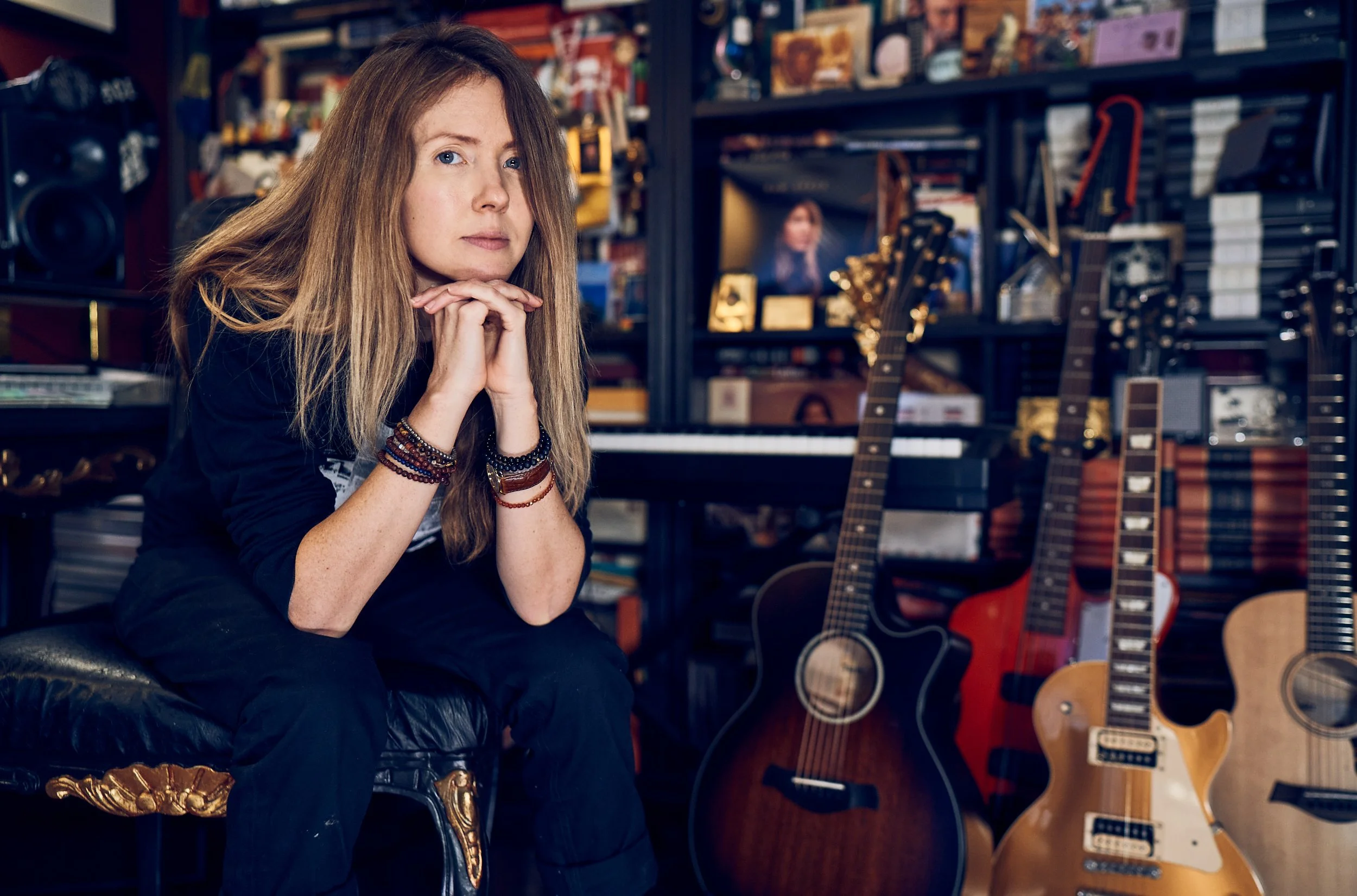
Forbes profile imPRINTING by Beatie Wolfe at Museum of Science Boston
Forbes Leslie Katz’s explores imPRINTING’s US première which will be a highlight of the Museum of Science’s Being Human 2025
Pick Up The Phone And Listen In On Artist Beatie Wolfe’s Brain
Leslie Katz, Senior Contributor
Jan 29, 2025,08:00am EST
What’s it like to step inside someone else’s mind? That’s the question conceptual artist and composer Beatie Wolfe invites visitors to explore with her installation “Imprinting,” a sprawling sonic self-portrait of her brain getting its U.S. debut at Boston’s Museum of Science this week.
The installation features listening stations where participants tune in to “channels” that broadcast Wolfe’s original soundscapes — mosaics of conversations, music, poems and random sounds, each representing different regions of the brain and their respective functions. One station, for example, focuses on the cerebral cortex, which is involved in complex tasks such as reasoning and problem solving, while another highlights Wernicke’s area, considered key to language comprehension.
The channel for the limbic system, a part of the brain that gets activated when we listen to music, plays Wolfe’s own compositions, from her first taped demo as a 9 year old to present songs that lean toward folk and indie rock. For the channel connected to the hippocampus, the brain’s primary memory center, the Anglo-American artist recorded herself reading many hours of old journal entries spanning her adolescence.
“If you were to listen to that, you’d hear essentially someone aging from 11 to 19 — these inner monologues, thoughts, reflections, poems, rants, transmissions, breakdowns, breakthroughs,” Wolfe said over Zoom from London, where she lives when not in Los Angeles. “The way I think about it is if that area of the brain could speak, that’s probably what it would sound like.”
“Imprinting,” which premiered at the 2023 London Design Biennale, opens at the Museum of Science on Thursday and runs through the end of the year. The piece is both deeply personal and universally resonant, offering a window into Wolfe’s inner world while inviting visitors to reflect on their own.
“By creating a sonic brain self-portrait, it’s almost as if you create a way for other people to think what their own sonic self-portrait would be,” Wolfe said. Those unable to attend the exhibit will be able to call in to each listening station by phone using the numbers listed below.
Breaking Down Neuroscience Barriers
The stations connect wall-mounted vintage phones to a retro-futuristic data-encoded aviation cap fitted with eight glass data discs, each tied to audio from a different listening station. The bespoke hat, stored behind glass at one end of the installation, was designed by Mr. Fish, the iconic U.K. fashion brand that dressed David Bowie, Jimi Hendrix and Mick Jagger in the 1970s. Mr. Fish also created a wearable jacket for Wolfe’s 2016 album Montagu Square that let people hear its songs by tapping their phone to fabric embedded with short-range wireless technology.
For each “Imprinting” channel, Wolfe edited hundreds of hours of audio to ensure no listener hears the same sequence twice, and she collaborated with Microsoft Research Labs to encode the vast aural landscapes in the “thinking cap” connected to the phones.
For most people, clinical terms like medial prefrontal cortex won’t immediately evoke the intricacies of emotional regulation and social behavior that that part of the brain influences. The Museum of Science says “Imprinting” transforms these concepts into relatable, sensory experiences.
“The installation breaks down barriers around neuroscience and terms that can be intimidating or sterile by connecting them to our everyday experiences,” James Monroe, the museum’s creative director of programming, said in an email interview. “Our ability to collaborate, the way we communicate and build relationships, our artistry, the moments we hold dear to us throughout our lives… all of these treasured aspects of being human are directly connected first and foremost to our brain, and I think Beatie illustrates this in a singular and profound way through ‘Imprinting.’”
Inspired By An Oliver Sacks Book
Wolfe became fascinated with the mysteries of the brain after reading neurologist Oliver Sacks’ 2007 best-seller Musicophilia: Tales of Music and the Brain, which she now calls her favorite book. In it, Sacks investigates the power of music to move and heal us.
“Even if you read a couple of case studies it changes your whole perspective on what music is,” Wolfe said.
When the artist’s father-in-law was diagnosed with dementia, the book’s insights inspired her to see what would happen if she performed music for residents of his Portuguese care home. Standing at the front of the room with her guitar playing original new songs — tunes the residents wouldn’t have recognized, and in English, a language most didn’t speak — she didn’t anticipate much of a reaction.
Instead, “I was seeing people waking up and singing along in their version and clapping,” Wolfe said. “At the end of the performance, the director of the care home said, ‘In the 16 years I’ve been here, this is the best I’ve ever seen the group. This is amazing.’”
That experience led Wolfe to conduct extensive research with Stanford University scientists into music, memory and dementia. “Music is so beyond entertainment,” she said. “It is key to our sentience as human beings in ways we’re only just beginning to understand.”
“Imprinting” is a centerpiece of the Museum of Science’s 2025 offerings related to the theme “Being Human.”
“We will explore all aspects of humanity,” the museum’s Monroe said. “Our brains and bodies, our communities, how technology has impacted and improved our lives, and what is inside that connects us all.”
How To Call Into The Listening Stations Remotely
Here are the numbers you can dial to hear each soundscape in “Imprinting.”
“Conversations” channel (representing Wernicke’s area): 617-589-0001
“Collaborations” channel (representing the medial prefrontal cortex): 617-589-0002
“Inner Self” channel (representing the hippocampus): 617-589-0003
“Outer Self” channel (representing the cerebral cortex): 617-589-0004
“Memory” channel (representing the neocortex): 617-589-0005
“Sounds” channel (representing the primary auditory cortex): 617-589-0006
“Music Rewind” channel (representing the limbic system): 617-589-0007
“Music Forward” channel (representing the limbic system): 617-589-0008
Journalist Leslie Katz, a Forbes contributor since October 2023, covers science
Material Matters on Beatie Wolfe
Material Matters editor Grant Gibson sits down with Beatie Wolfe
BEATIE WOLFE - MUSIC AND MATERIAL
28.06.23. INTERNET
Beatie Wolfe is a musician and artist, who has in her time been described as a ‘musical weirdo and visionary’ and one of the ‘22 people changing the world’.
In a relatively short career she has: created a 3D interactive album app and a musical jacket; worked in the world’s quietest room to develop an ‘anti-stream’; fired her music into space; made a documentary with the Barbican; designed an environmental protest piece, entitled From Green to Red, which was shown at the Nobel Prize Summit; worked with people suffering from dementia; and recorded a track for a 12 inch record made of bioplastic, alongside Michael Stipe.
Her latest project, Imprinting: The Artist’s Brain, was on show as part of the recent London Design Biennale at Somerset House, and is a sonic self-portrait that involves old-school telephones as well as a thinking cap designed by an iconic tailor.
The theme running through all this is her desire to ‘re-materialise’ music and give it back a sense of ‘tangibility and ceremony’.
In this episode we discuss: keeping space rock in her pocket; her latest project at the London Design Biennale; being self-critical as a child; writing her first songs aged nine; working with renowned tailor Mr Fish; the importance of collaboration; sending her music into space; finding the balance between innovation and tradition; her childhood desire to be a ninja; being in a grunge band; the power of art; and the importance of neurologist Oliver Sacks to her career.
TEDMED talk "How music can rescue and restore our humanity” from Beatie Wolfe
In Boston, moments before our global lockdown, TEDMED invited Beatie Wolfe onto the health and medicine stage of its world-famous TED conference to share her talk "How music can rescue and restore our humanity”
Beatie Wolfe on TEDMED stage - Boston 2020
Film | Orange Juice for the Ears | Virtual Design Festival | Dezeen
To kick off today's VDF collaboration with Beatie Wolfe, we're exclusively streaming the online premiere of the singer-songwriter's documentary Orange Juice for the Ears: from Space Beams to Anti-Streams.
VDF premieres Beatie Wolfe's documentary Orange Juice for the Ears
Marcus Fairs | 9 hours ago Leave a comment
To kick off today's VDF collaboration with Beatie Wolfe, we're exclusively streaming the online premiere of the singer-songwriter's documentary Orange Juice for the Ears: from Space Beams to Anti-Streams.
The documentary, which has never been streamed online before, will be available free to Dezeen readers for the duration of Virtual Design Festival.
The film premiere will be followed at 1:00pm by an exclusive preview of Wolfe's forthcoming environmental protest piece Red to Green, and an essay by Wolfe in which she explores the power of music to improve the human mind and ease the suffering of people with dementia.
At 5:00pm UK time Wolfe will conduct a live interview with Dezeen founder Marcus Fairs, followed by an exclusive performance of her music.
Wolfe "pioneers new formats for music"
Commissioned by the Barbican Centre last year, the 30-minute Orange Juice for the Ears documentary explores the work of Wolfe, a singer-songwriter based in Los Angeles.
The Barbican Centre described Wolfe as "a singer-songwriter of raw acoustic indie channelling Leonard Cohen and Elliott Smith, Wolfe also pioneers new formats for music."
Photo by Ross Harris
Beatie Wolfe is a singer-songwriter based in Los Angeles
Directed, shot and edited by Ross Harris, the film premiered at the Barbican Centre in London in October 2019, followed by an industry screening in Los Angeles. The film was commissioned as part of Barbican Centre's Life Rewired season, which explored how artists are responding to rapid technological change.
"With the season investigating the impact of the pace and extent of technological change in our culture and society, and looking at how we can grasp and respond to the seismic shifts these advances will bring about, there are few artists who exemplify this exploration as much as Beatie Wolfe," Barbican Centre said.
Music "can lift us out of depression"
The film's title comes from a quote by the late neurologist Oliver Sacks, who explored the relationship between music and the human mind.
"Music can lift us out of depression or move us to tears — it is a remedy, a tonic, orange juice for the ear," Sacks wrote in his book Musicophilia: Tales of Music and the Brain.
Photo by Ross Harris
Virtual Design Festival is hosting an exclusive stream of Wolfe's documentary Orange Juice for the Ears
"But for many of my neurological patients, music is even more – it can provide access, even when no medication can, to movement, to speech, to life. For them, music is not a luxury, but a necessity.”
Born in London, Wolfe has pioneered new ways of combining music with design and technology. She released her debut EP, Burst, as an iPhone app in 2010, making her one of the first artists to explore the potential of apps as a format for musicians.
Pioneer of new musical formats
In 2013, her debut album 8ight was released on vinyl, in book form and as the "world's First 3D interactive album app".
Her second album, Montagu Square, was recorded live at 34 Montagu Square in London, which was at various times the home of Jimi Hendrix, Paul McCartney, Ringo Starr, John Lennon and Yoko Ono.
Raw Space was issued as a set of NFC-enabled business cards
Recorded in the room where The Wind Cries Mary and Eleanor Rigby were written, the album was accompanied by a "musical jacket" created by fashion designer Michael Fish, who dressed rocks stars including Hendrix, David Bowie and Mick Jagger.
Intended as a way of recapturing the lost emotional connection listeners used to have with vinyl album sleeves, the tailored jacket contained near-field communication (NFC) chips that allow tracks from the album to be played when a smartphone is held up to the garment.
Album recorded in "world's quietest room"
The Montagu Square album includes the track Take Me Home, an instrumental version of which was used as the soundtrack for the Virtual Design Festival launch movie.
Wolfe's 2017 album Raw Space was recorded in Bell Labs' anechoic chamber, a room described as "the quietest room in the world".
Related story
Lockdown is an "exercise in presence and gratitude" says Beatie Wolfe
The album was released as the "world's first live 360 AR stream". The album later became the first to be broadcast into space via the Holmdel Horn Antenna.
The Raw Space album was later issued as a set of NFC-enabled business cards, each of which was designed by a different graphic designer.
Solo exhibition at V&A
In 2018, London's V&A museum hosted a solo exhibition of Wolfe's work titled The Art of Music in the Digital Age: a series of world-first designs.
"Beatie Wolfe presents a series of album innovations that explore how technology can be used to recapture a sense of storytelling, ceremony and tangibility for music in the digital age," wrote the V&A about the show, held as part of London Design Festival 2018.
The documentary artwork is by Kizzy Memani of ArtCenter College of Design.
About Virtual Design Festival
Virtual Design Festival runs from 15 April to 30 June 2020. It intends to bring the architecture and design world together to celebrate the culture and commerce of our industry, and explore how it can adapt and respond to extraordinary circumstances
TEDMED2020 x Beatie Wolfe - the script
At TEDMED Beatie Wolfe brings the artful core of our humanity to life through music that highlights the depth of our human intention for storytelling and ceremony.
Talk In A Nutshell
Beatie Wolfe brings the artful core of our humanity to life through music that highlights the depth of our human intention for storytelling and ceremony.
The Script
Opening Story
I’ve always loved the stories of albums, the tangibility of records and the ceremony of listening. From the time I started writing songs (age 8) and discovered my parents’ record collection, I saw records as musical books, with the artwork providing the perfect backdrop for the story, and I loved opening them up and entering into the world of the album. There was also a ritual to the occasion. I started imagining what my album could look like, what it could feel like, what worlds I could create. When it was time for my first album to be released, it was a very different era with the digital replacing the physical. So I thought about how to connect the two and that’s what my work became centred around. Reimagining the vinyl experience but for today.
Statement Of Thesis: Music Is Core To Our Humanity
Why was this so important to me? Because music IS core to our humanity. We are a musical species more than anything else and music imprints on the brain deeper than any other human experience.
I believe that there are three things that allow something to go deep, to stay with us and forever change us. These are: tangibility, storytelling and ceremony.
Tangibility… as in a physical art form or space to explore… this could be a record jacket or the world’s quietest room… anything that grounds us in our present reality through a touchpoint.
Storytelling in the broadest sense of the word, the ability for the artist or creator to tell a story through their work that can engage the imagination and transport us.
And lastly but perhaps most importantly… Ceremony, the space around and within the experience that allows us to go deep, to be fully immersed.
I believe that these three things set the stage for the music and allow it to imprint. Imprint so that every one of those experiences becomes a part of who we are and what we carry with us. This doesn’t just apply to music, it applies to anything, everything that helps to reconnect us with ourselves and one another. It’s these experiences that help to keep us alive inside.
What Threatens These Musical Values Today?
Tangibility, storytelling and ceremony had always been part of the physical music listening experience and were just some of the things we lost when we moved to digital.
The digital era created access, it presented solutions but it also created an idea that we could fast track a lot of what defined us as humans to begin with and without the true cost or value reflected in the process.
Music now floats around in its intangible sphere as part of the background noise along with everything else that sits there… news articles, notifications, calendar reminders, social media… everything occupying this same superficial stream of information that infiltrates our day-to-day lives, bombarding our sensory systems until we are numb, overloaded and fatigued. Music, and art, have become part of that constant background chatter and we have forgotten why they are so much more.
How Can We Rescue Music And Restore Our Humanity? Science
There is a fine balance between what needs to be innovated and what needs to be preserved. So how do we reconcile the value of music and art in an industry that has decided that albums are obsolete and that singles need not be more than jingles, forgotten as easily as they are made? The opposite of imprinting.
I found part of my answer in neurology. The great late Oliver Sacks studied the power of music extensively and grounded what a lot of us feel intuitively about music, in science. In Musicophilia, his book about music and the brain, he documents the impact of music for every neurological condition from Parkinson’s to Alzheimer’s, Autism to Schizophonia, showing how music is a remedy, a tonic, an orange juice for the ear.
And I realised that there was no greater application of music than this healing application… using music to reconnect us with ourselves and one another when nothing else could.
A seed was planted in the back of my mind and when I found out that my grandmother had been diagnosed with dementia I decided to take my guitar with me the next time I visited her and play her my songs… because why not?
Surprising Impact Of Live Performance For Patients With Dementia
Watching my grandmother transform from being confused and agitated to joyful and relaxed with just a song, moved me so deeply. I then decided to play for my father-in-law at his care home in Portugal and when the home director asked if I would play to everyone in the ward living with dementia and Alzheimer's, of course I agreed. Realising that no one in the home spoke English (except for my relative) and that my songs were unfamiliar to the residents, I expected a nice ambience at best. However watching people start to wake up, engage, clap along, even dance in their chairs, and become visibly reanimated from the music, just as Oliver had described, I realised that something important was happening.
And then the director informed me it was the best he had seen the group in the 10 years he had been there.
Something was crystalizing into view. What if music’s power was so strong, so interlinked with our own sense of self and wellbeing, that even without the memory component it could be a tonic, a remedy, a “way in”. What if it was the music and not the memory making the magic? In Musicophilia, Sacks had theorized that “music does not have to be familiar to exert its emotional pull” but he had not tested this. I had seen the tip of precisely this and wanted to see how much deeper it went.
Launch Of Research Project
Inspired by this insight, I began the Power of Music and Dementia research project with the Utley Foundation in 2014. The idea was to recreate what had occurred, naturally, in Portugal but this time with controls in place and the caregivers and doctors monitoring the residents. The intention was to show that even when memory was taken out of the equation the power of music prevailed.
As part of this project, I went into care homes all across the UK and performed a set of my original songs while the residents were monitored both during the live performance and the weeks following as they listened to the same songs on headsets.
The results were amazing. Both memory and communication were improved during the duration of the project and I saw some of the most powerful reactions to music I have ever seen. Reactions that imprinted on me forever.
I watched David transform from a catatonic-like state to dancing. And Anne who had not spoken a word in 7 months; during the performance broke into song. Every one of these breakthroughs felt like the most vital link in the chain of our understanding about what moves us, what restores us, what makes us uniquely human.
Global & Academic Recognition; Launch Of Charity
What began as a small research study in the UK was then recognized by leading academic and research institutions and was suddenly getting global attention. I found myself sitting with the top neurologists and brain experts as they picked my brain on the subject. And all because I asked a question, not as a doctor but as a musician.
Today music for dementia is becoming a global movement. The charity, MusicForDementia2020, (established out of my project) is now actively working to get music in all care homes in the UK by the end of this year and I continue to work with them as an ambassador.
Conclusion / Restatement Of Thesis: Core Power Of Music
So what did this teach me? It taught me to celebrate the experiences that keep us alive inside, that remind us of why we are here in the first place. At a time of more access than ever, how can we retain a sense of value? How can we choose to carve out deeper moments within the noise? How can we protect those endangered experiences that become our touchpoints, that shape our emotional sensibility, our identity, our wellbeing and create vast canyons and reserves in our very being?
We realise the importance of these choices when we realise the intrinsic value of music, and art, to us all as sentient beings.
When you have witnessed the power of music as medicine in this pure and concentrated way, which cannot be staged or fabricated. It either works or it doesn’t. When you see what music can do, even when language or memory are removed from the folds, see how the first few notes evokes a smile, a hand twitch, instantly, effortlessly and this builds and grows and it’s just them and the music... No tangible memories, no narrative, no point in time. Just them and the music, there and now. And the brain opens up like a flower, gently unfurling, presenting new pathways you never believed were there…
And you realise… that music is a necessity for those living with dementia because music is a necessity for every one of us.
DLD News profiles Beatie Wolfe
Alumni update: DLD check out what’s new with Beatie Wolfe and her Music & Dementia project?
The Healing Power of Music
August 20, 2019
Alumni update: What’s new with Beatie Wolfe and her Music & Dementia project?
Try this: Type “music is…” into your favorite search engine and you’re probably seeing suggestions like “my life”, “my best friend” and “my savior”.
This illustrates how important music is to most of us. Listening to the right beat, a catchy melody or touching vocals can lift us up, provide comfort or give us the energy to make it to the finish line – in sports and at work.
British singer-songwriter Beatie Wolfe has been researching the healing powers of melodies for the mind in her Music & Dementia project. Inspired by neurologist Oliver Sacks and his book Musicophelia – Tales of Music and the Brain, Wolfe started giving private concerts to her grandmother who had been diagnosed with dementia.
“Afterwards I would get letters from the carers saying that she’d been so much better the days after the music”, Wolfe recalled at DLD Summer 2015 when she first presented the results of her own project. Supported by the Utley Foundation, a charitable trust, the singer had performed at nursing homes throughout the U.K. – showing that music could significantly benefit patients with Alzheimer’s and other forms of dementia.
Wolfe’s work sparked the interest of Stanford and Oxford universities as well as the American Alzheimer’s Association. It also resulted in the creation of a charity, Music For Dementia 2020, which aims to make music readily available for everyone living with dementia in Britain by next year.
“Seeing the incredible impact, I felt there was a responsibility to take the project further”, Wolfe says today. And while she’s busy pursuing new avenues as an artist, she remains committed to being a vocal ambassador for the advancement of music and dementia research. Her hope is to bring policymakers and health-care providers to pay more attention to the topic – far beyond the U.K. “I’m trying to spread the message and make this much more commonplace”, Wolfe says.
In her new, weekly radio show called Orange Juice for the Ears the 31-year-old singer is exploring the power of music on a more personal level. In each episode (also available as a podcast), Wolfe talks to her guests about songs and artists that have impacted them throughout their lives.
“Music is a universal connector”, Wolfe tells DLD. “It encompasses everything that is stimulating to us.”
Her guests have included Emmy-winning writer and producer Donick Cary (The Simpsons, Parks & Recreation, Silicon Valley), artist manager Janet Billig Rich and Nobel Laureate Dr. Robert Wilson. The astronomer previously collaborated with Wolfe on her Raw Spaceproject, helping her to beam her music into the vastness of the universe via the historic Bell Labs Holmdel Horn Antenna.
Wolfe is known for her love of experimentation. For her debut album she created an interactive app with 3D effects, lyrics and liner notes. NFC chips brought her second album to life: Wolfe designed a tailored suit – a literal album jacket – for her music, and listeners could tap their phones on the NFC chips woven into the fabric to play select songs. Most recently, Raw Space, her third album, was released as “the world’s first live 360° AR experience”.
While she’s busy exploring the creative possibilities of new technologies, there’s also a longing for the past in Wolfe’s experiments. “Growing up, I was completely obsessed with art and storytelling in any form”, she says. But as CDs gave way to downloads, and playlists on streaming services replaced the concept of albums she felt dismayed. “By the time I grew up a lot of what I loved was made irrelevant. The tangible had been replaced by digital.”
Wolfe’s answer has been to adopt technology to “figure out what could be the best of both worlds” because she’s eager to show that music deserves to be more than “a kind of background noise” – even if songs are permanently raining down from the Cloud these days, thanks to Spotify, YouTube, Deezer, Pandora and many other services.
“For me it’s about raising the bar”, Wolfe says. “Everything I’m doing is about reminding people how music can go beyond entertainment.”
A new documentary which chronicles her quest will debut in October. At the same time Wolfe is working on her newest project, a visualization of the CO2 concentration in the Earth’s atmosphere. “It’s part music video and part protest song”, she says. “And entirely interactive.” Stay tuned.
Orange Juice for the Ears
Here’s a sneak preview of the new documentary about Beatie Wolfe, directed by Ross Harris
Barbican Commission Film on Beatie Wolfe
Super excited about the @BarbicanCentre commissioning this film on me, just announced, directed by the @imrossangeles
The Daily Mail feature Beatie Wolfe's Power of Music & Dementia work
You Magazine highlight the work of The Utley Foundation and Beatie Wolfe

Beatie Wolfe's Me Convention Keynote & Performance Videos & Music
Beatie Wolfe invited to perform at SXSW's inaugural European Festival, Me Convention
Me Convention - September 16th, 2017 (SXSW's Inaugural European Festival)
Beatie Wolfe's Presentation Videos and Music
The Raw Space Experience - Video Documentary (5min)
Further Supporting Videos (2D, 360 & VR) & Links
Little Moth - The World First Live Stream 360 AR Music Video
Little Moth, written in tribute of Elliott Smith, is the opening track off Beatie Wolfe's new album Raw Space.... read the lyrics
The 'Take Me Home' Musical Jacket - Music Video Documentary (4mins)
Further reading & read the lyrics
The Man Who by Beatie Wolfe
Read the lyrics or add to your streaming playlists...